Metabase: a data dashboard to run your business in 2026
Metabase for SMBs: centralize your data, build dashboards and track your KPIs in real time. A comparison with Power BI and Looker, and the tool's limits.
 Tech · 6 min
The era of agents that just chat is over. In 2026, interoperability no longer depends on dozens of custom API integrations, but on a single standard: the Model Context Protocol. Here is how to turn your SaaS from a simple passive tool into an 'Agent-First' ecosystem.
The Model Context Protocol (or MCP) is an open protocol, initially launched by Anthropic in late 2024, that standardizes how artificial intelligence models access data and tools.
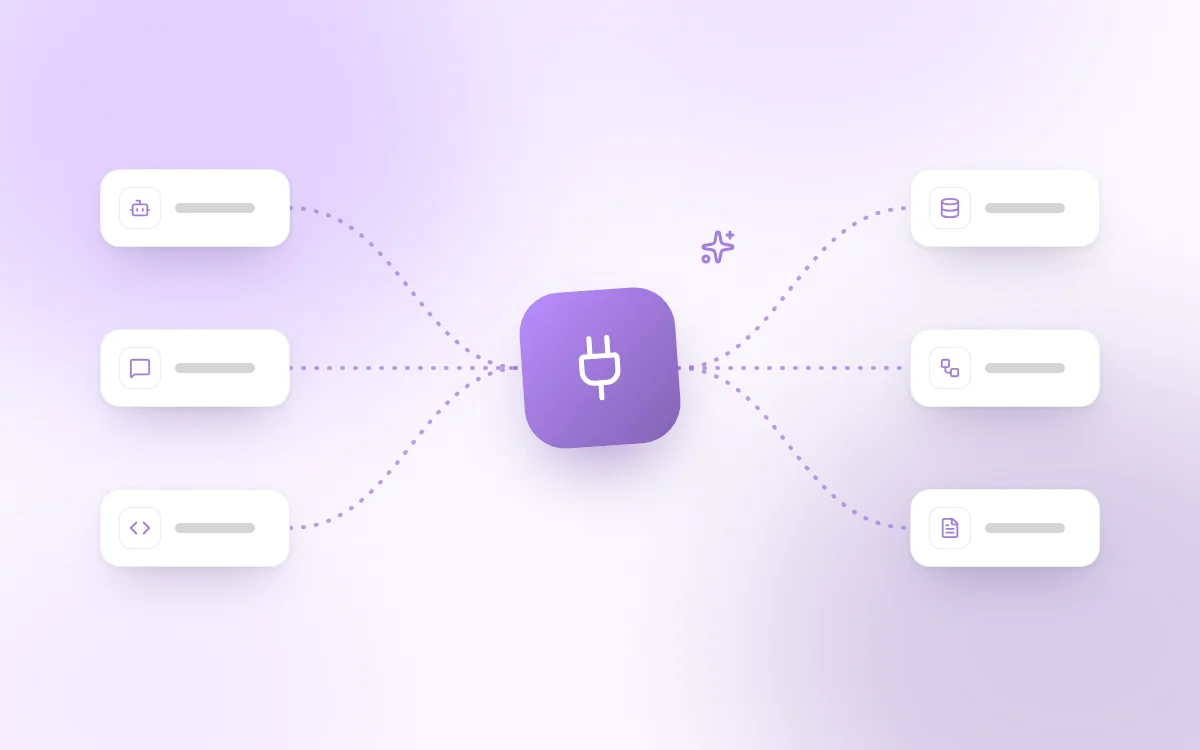
Before its dominance, every software vendor had to build its own connectors so that Claude, ChatGPT or IDEs like Cursor could interact with its data. In 2026, we are seeing a major shift: MCP acts as the 'USB port' for AI context.
It lets any agent plug instantly into your database, your CRM or your project management tool without you having to rewrite an integration layer for each new LLM. For a CTO, this means development effort is no longer spent maintaining n integrations, but on the quality of the context exposed.
The Agent-First architecture concept rests on a simple idea: your product should not only be designed for humans clicking buttons, but for autonomous agents able to read and write data through a standardized channel.
According to recent industry benchmarks, companies that adopted a native MCP server saw third-party agents' use of their APIs increase by +45% in just 12 months.
Building an Agent-First SaaS with MCP requires a paradigm shift. Unlike a classic REST API, where the user (or script) must know exactly which endpoint to call, MCP lets the agent dynamically discover your tool's capabilities.
At the heart of this architecture is the MCP Server. It is a lightweight component that exposes three essential elements to the AI:
At Fragments Studio, we help our clients set up these architectures. To learn more about our methods, discover our web development expertise.
Adopting MCP is not just a technical trend, it is a Product-Market Fit imperative in a world where users increasingly work through agents (such as Windsurf or Replit Agent).
The competitive advantage is twofold:
A study published by Sourcegraph in 2025 shows that implementing a context standard reduces integration maintenance costs by 30% on average.
By exposing your tools via MCP, you instantly become compatible with the whole ecosystem of AI-Integrated Development Environments and agent orchestrators. You are no longer building an isolated application, but an integrated building block of intelligence.
If you want to turn your current SaaS into an Agent-First platform, here is the approach we recommend at Fragments Studio:
For complex projects that require a robust architecture, our custom development team can help you design this interoperability layer.
What is the difference between MCP and classic Tool Calling? Tool Calling (or function calling) is a specific feature of a model (e.g. OpenAI). MCP is a universal protocol: you write your server once, and it works with Claude, Gemini, or any agent that supports the standard, with no additional code.
Does MCP replace REST APIs? No, MCP often builds on your existing APIs. It acts as an abstraction and translation layer that makes your REST APIs natively understandable and usable by AI models.
Is the MCP protocol secure for sensitive data? Yes, because MCP strictly separates the host (the model) from the server (your data). The MCP server runs in your infrastructure or locally, and you control precisely which data is exposed to the model through strict access policies.
Which tools already support MCP in 2026? Almost all the major players: Claude Desktop, Cursor, VS Code (via extensions), GitHub, and many smart terminals. It has become the de facto standard for connecting third-party data to LLMs.
Moving from a 'Chatbot' approach (where the user has to copy and paste everything) to an Agent-First approach via the Model Context Protocol is the most powerful growth lever for SaaS in 2026.
By becoming 'programmable by AI', your software no longer just offers an interface; it becomes an active capability within the user's operating system.
Implementing the MCP protocol is a strategic step to avoid being isolated in today's AI ecosystem.
Follow Fragments Studio on Google
Add us to your preferred sources and our articles get surfaced first in Top Stories, AI Overviews and AI Mode.
 Tech · 6 min
Metabase for SMBs: centralize your data, build dashboards and track your KPIs in real time. A comparison with Power BI and Looker, and the tool's limits.
 Tech · 6 min
Using Cursor as a team in 2026: how to set up .cursorrules, share context, keep your code secure and compare Cursor with Claude Code and Copilot.
 Tech · 7 min
Scalable software architecture for SaaS in 2026: modular monolith or microservices, horizontal scaling, caching, message queues and the mistakes to avoid.
Fragments Studio handles everything: from strategy to production.
Discuss my project