Metabase: a data dashboard to run your business in 2026
Metabase for SMBs: centralize your data, build dashboards and track your KPIs in real time. A comparison with Power BI and Looker, and the tool's limits.
 Tech · 6 min
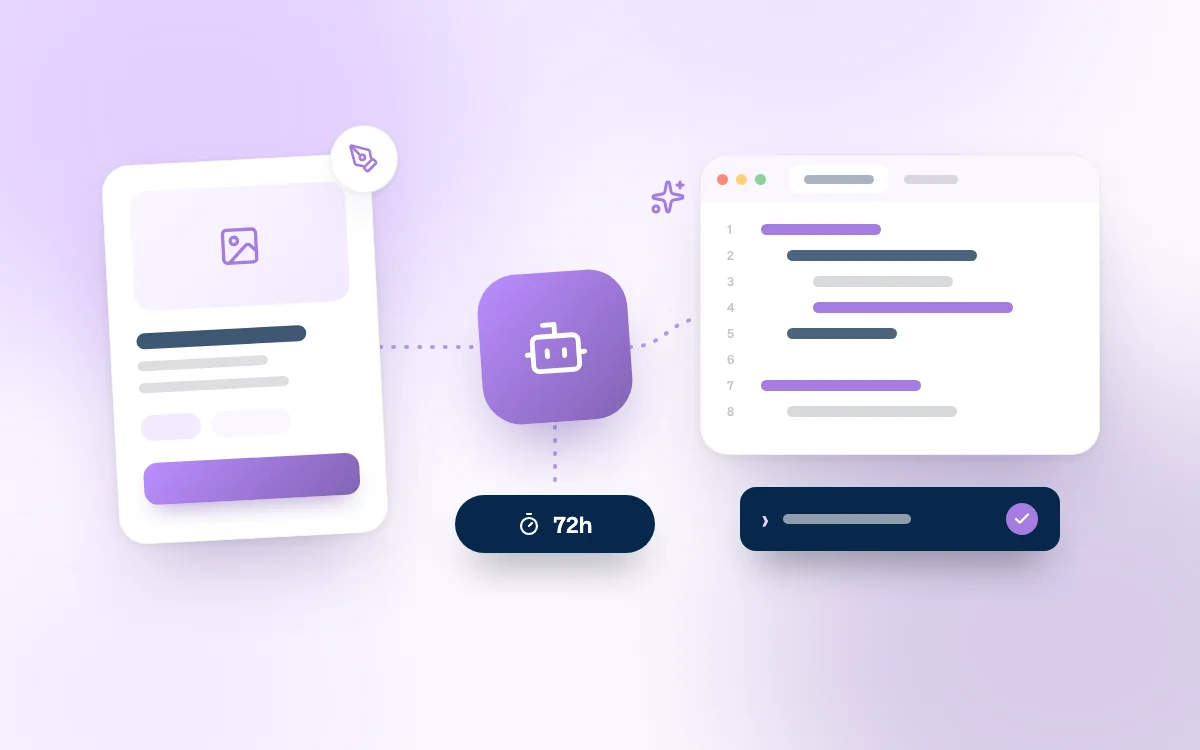
In 2026, the gap between design and code is no longer crossed, it is automated. The promise of delivering a working application in just three days from a Figma mockup has gone from marketing fantasy to an everyday production tool for agile teams. At Fragments Studio, we tested these new workflows to separate fact from fiction.
An AI Agent is an autonomous system capable of understanding a complex goal, planning steps and using tools (such as an IDE or an API) to achieve it without constant human intervention.
Unlike the simple copilots of 2024, today's agents no longer just suggest a line of code: they drive the entire software delivery chain.
In 2026, the integration of protocols such as the MCP Server (Model Context Protocol) has allowed agents like Claude Code or custom instances to directly read the layer tree of Figma.
Thanks to the use_figma server, an agent can now interpret not only the pixels, but also the layout constraints, the design system variables and the prototyping interactions to generate structured, maintainable code.
Going from idea to production in 72 hours is now a reality for Minimum Viable Products (MVPs) and business applications.
This acceleration relies on the drastic compression of the front-end development and integration phases.
| Phase | Traditional workflow | AI agent workflow (2026) |
|---|---|---|
| Design System integration | 2 to 4 days | 15 minutes (via MCP) |
| Front-end development | 2 to 3 weeks | 6 to 8 hours |
| Unit tests & QA | 1 week | 2 hours (auto-generated) |
| Deployment & CI/CD | 1 day | Automated in 10 minutes |
According to the latest internal benchmarks at Fragments Studio, using tools like the Anima API combined with orchestration agents makes it possible to generate pixel-perfect React or Vue code 1,000 times faster than in 2023.
The time freed up lets developers focus on system architecture and security, rather than on adjusting CSS margins.
This year's major innovation lies in AI's ability to understand the business context behind a geometric shape.
PrimaryButton component tied to a submit action.Discover our web development expertise to understand how we integrate these tools into our projects.
While 72h is achievable for the front end and simple logic, "real" complex software still requires expert human supervision.
At Fragments Studio, we see that while AI reduces the QA workload from 20% to less than 10%, it does not replace strategic vision.
Production deployment remains critical for:
For complex projects, our custom development team uses AI agents as force multipliers, while keeping strict control over the quality of the deliverable.
What is a Figma-to-Prod workflow?
It is an automated process in which an AI agent extracts the specifications of a Figma mockup, generates the corresponding front-end code, configures the routes and deploys the application to a staging or production environment almost autonomously.
Is AI-generated code clean?
In 2026, yes. Thanks to Design Systems and context instructions, agents produce code that meets standards (Typescript, Tailwind CSS, atomic components) and no longer requires major refactoring, unlike the "low-code" tools of the past.
Which tools should you use for a 72h project?
We recommend using Figma AI to prepare the layers, the Anima API as the bridge to code, and an orchestrator agent like Bolt.new or Lovable for assembly and deployment on Vercel or AWS.
Can you build a complete application (including the backend) in 72h?
Yes, for a prototype or a simple management application. For complex systems with legacy integrations, the 72h generally cover the front end and the interface logic, as the backend often requires a longer scoping phase.
The 72h promise is no longer a myth for those who know how to orchestrate the right agents. In 2026, the developer's role is evolving: they become a systems pilot rather than a translator of mockups.
This agility lets founders test ideas on the market with unprecedented velocity, radically reducing the cost of failure and speeding up the path to success.
Going from idea to reality has never been faster, provided you have the right technical foundations.
Follow Fragments Studio on Google
Add us to your preferred sources and our articles get surfaced first in Top Stories, AI Overviews and AI Mode.
 Tech · 6 min
Metabase for SMBs: centralize your data, build dashboards and track your KPIs in real time. A comparison with Power BI and Looker, and the tool's limits.
 Tech · 6 min
Using Cursor as a team in 2026: how to set up .cursorrules, share context, keep your code secure and compare Cursor with Claude Code and Copilot.
 Tech · 7 min
Scalable software architecture for SaaS in 2026: modular monolith or microservices, horizontal scaling, caching, message queues and the mistakes to avoid.
Fragments Studio handles everything: from strategy to production.
Discuss my project