E-commerce 2026: Shopify, headless or custom?
Which e-commerce platform should you choose in 2026? Compare Shopify, headless and custom development to optimize your conversion and performance.
 Product · 5 min
Integrating artificial intelligence into SaaS tools has become standard. It is no longer limited to a technical demo: it is transforming the very structure of products.
Every week, new tools promise to automate, assist or predict thanks to AI models. But in practice, building a SaaS that embeds an AI component, whether for generation, search or autonomy, requires in-depth work on the product, the UX and the architecture.
At Fragments Studio, we support several projects where AI is at the heart of the value proposition. What we see is that AI does not replace product rigor: it demands it. You have to think through the user logic, the feedback loop, the reliability of the answers and above all how understandable the system is. That is the condition for an AI product to become credible, usable and sustainable.
Many founders start with the idea that integrating AI simply means calling an OpenAI, Anthropic or Mistral API... But the reality is much more complex. Each of these models has its own strengths, token limits, specific performance and, above all, its own requirements for context.
The way you build the messages sent to the AI (the prompt), the settings that influence its behavior (such as temperature, which makes answers more or less creative, or top-p, which restricts the words used for more consistency), the format of the expected answers (text, table, code, JSON...), and the time the AI takes to respond: all these elements have a direct impact on the user experience. And in a SaaS, there is no room for visible approximations. The tool must stay smooth, reliable and consistent at every interaction.
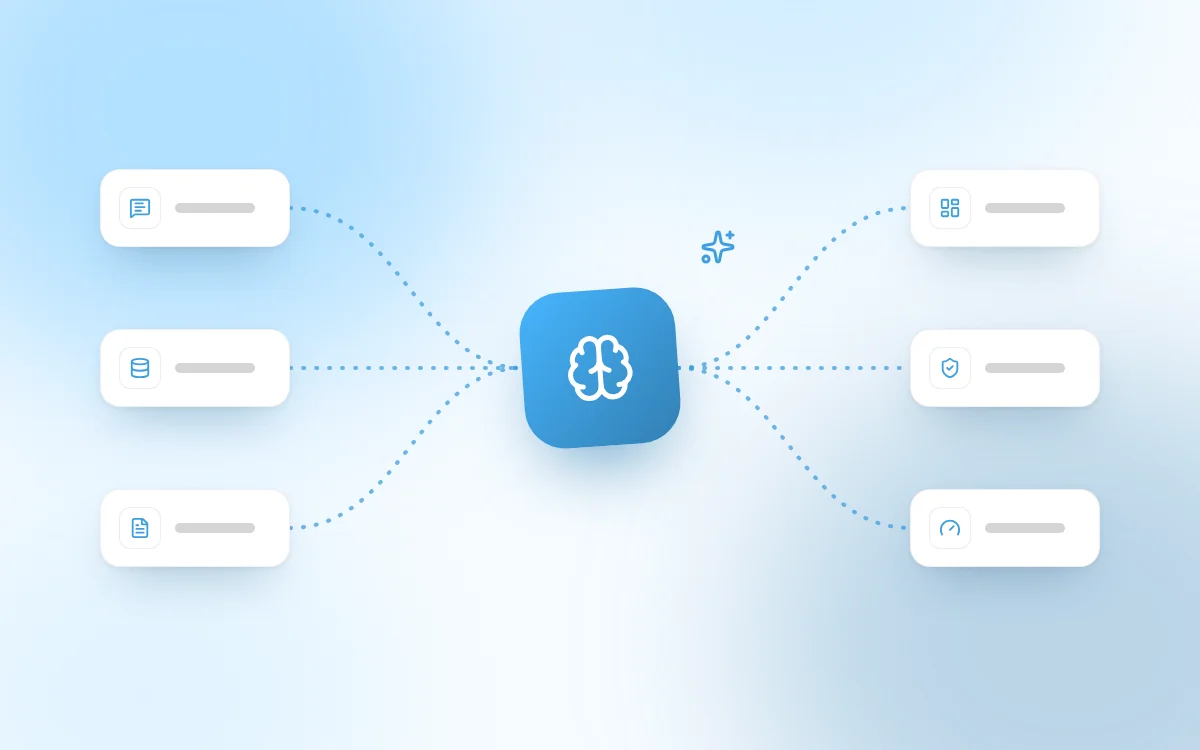
That is why most serious AI tools implement a dedicated orchestration layer. This layer normalizes calls, dynamically adapts prompts, provides smart "retries" in case of failure, and routes requests to the most relevant model (depending on context, cost or language, for example).
The user experience in an AI SaaS rests on a simple principle: the AI generates, but the human decides. Users must understand what the tool does, why it does it, and how to react when the result is unsatisfactory. The UX must therefore be designed to channel an uncertain answer into a predictable framework.
This means explicit interfaces: visual feedback during generation, options to regenerate or rephrase, interaction histories, and sometimes a concise explanation of the AI's reasoning. Some platforms even display "confidence scores" or simplified logs to promote transparency.
In more advanced tools, we are seeing "block" or "card" interfaces emerge (as in Notion AI, Jasper or Superhuman AI) that frame the AI output while letting the user edit, annotate or reject it. This UX flexibility is essential to building trust.
In some cases, integrating AI into a SaaS can seem simple: you call an API, display an answer, and it works. And indeed, for one-off needs such as text generation, automatic summaries or rephrasing, this approach can be enough, as long as the experience is well framed.
But as soon as you start building a product where the AI makes decisions, interacts with multiple data sources, or has to adapt to more business-specific uses, complexity rises quickly. It is no longer just an API call, but a complete orchestration around the AI.
In these cases, the architecture must absorb very specific constraints: variable latency, uncertain answers, parallel processing, user personalization, storage of conversation history and context.
And if the tool handles sensitive data such as HR, health, finance or legal data, you need to go even further: encrypted exchanges, fine-grained permission management, auditing of AI answers, or even hosting open-source models (such as Mistral or Ollama) on dedicated servers to keep inference under control locally.
Too often, the AI product is designed around the model, not around the user. That is a strategic mistake. A good AI SaaS (like any product) must start from a clear use: a task, a need, a business context. AI then reinforces that logic, it does not replace it.
This means thinking about the limits of automation, the cases where a human must step in, and how users can take back control. Prompt engineering becomes a product component in its own right here, with dynamic system instructions, slots to fill, version logs, and sometimes decision trees to script the answers.
A tool like Flowise or Superagent, for example, lets you visualize the logic of an agent, version its behaviors, and manage specific permissions per action. This kind of design is what allows an AI SaaS to move from prototype to a usable business tool.
Finally, the question of how users build up their skills is key. An effective AI SaaS is not one that offers every option at once, but one that lets users progress gradually. You can imagine "starter", "advanced" and "expert" modes, or guided templates with room for exploration.
This logic can already be seen in tools like Notion AI or Claude, which offer a progressive approach to prompting, or in platforms like Dust or Cognosys, which let you create agents through a low-code or semi-graphical interface. What matters is that users are never stuck, and that they understand what the AI is doing at each step.
Building a SaaS with an AI component is not a passing trend. It is a demanding but exciting undertaking that combines architecture, product strategy, user understanding and technical excellence. It is not a feature. It is a project.
At Fragments Studio, we support this kind of product from A to Z, from the idea to development, including scoping, UX design and technical implementation.
If you are considering launching or evolving a product with an AI component:
Follow Fragments Studio on Google
Add us to your preferred sources and our articles get surfaced first in Top Stories, AI Overviews and AI Mode.
 Product · 7 min
Which e-commerce platform should you choose in 2026? Compare Shopify, headless and custom development to optimize your conversion and performance.
 Product · 6 min
Reduce your time to market in 2026: scope creep, design sprints, MVPs, reusable blocks, AI agents and the Fragments method to launch an MVP in 6 weeks.
 Product · 6 min
Discover how ChatGPT Ads is transforming customer acquisition in 2026. An analysis of formats, performance and strategies for your marketing mix.
Fragments Studio handles everything: from strategy to production.
Discuss my project