Metabase: a data dashboard to run your business in 2026
Metabase for SMBs: centralize your data, build dashboards and track your KPIs in real time. A comparison with Power BI and Looker, and the tool's limits.
 Tech · 7 min
You may have already tried asking ChatGPT or Perplexity to summarize a page on your site, only to be told that the tool cannot access it. This is not a technical bug in the AI, but an invisible barrier on your own platform that prevents the new search engines from reading and citing you.
Today, a growing share of web traffic no longer comes only from Google, but from tools like ChatGPT, Claude or Perplexity. These agents work differently from traditional search engines: they do not just list links, they extract information directly to answer the user.
If your site is invisible to them, you disappear from the generated answers and lose a major source of visibility. For an AI to cite you, it sends a robot (a crawler) to read your content.
But unlike a human, this robot is impatient and very sensitive to technical obstacles. If it runs into a closed door, it moves on to the next site within milliseconds. At Fragments Studio, we see that many sites, however good-looking, are genuinely impenetrable fortresses for modern algorithms.
This is the first obstacle, and often the most radical one. Many sites use Consent Management Platforms (CMP) that block the display of all content until the user has clicked "Accept all".
The problem? AI robots do not click buttons. If they hit a blocking cookie wall, they see an empty page. For them, your content simply does not exist.
Many modern sites use so-called Client-Side Rendering (CSR) technologies. In plain terms: the text is not hard-coded in the page's code; it is generated by a script after loading.
While Google's robots have become experts at running these scripts, the robots of Perplexity or OpenAI often favor speed and read only the raw HTML. If your text is not there from the very first millisecond, it remains invisible.
An AI "reads" a site to understand its hierarchy. Without clear tags (the well-known H1, H2, H3), it cannot tell a marketing slogan from crucial information. A page without semantic structure is perceived as an indigestible block of text.
According to a study by Search Engine Journal, sites with a clear structure see their AI citation rate increase significantly.
You do not need to be a developer to remove these barriers. Here are five levers you can pull directly from your content management interface (CMS) such as WordPress, Shopify or Webflow.
Each page should have a single H1 heading (the main topic). Then use H2 headings for your main sections and H3 headings for sub-points.
Think of these headings as a table of contents: the AI should be able to understand the content of your page by reading only the headings. Avoid vague headings like "Our approach" and prefer "Our approach to cybersecurity for SMBs".
AIs love the question-and-answer format. Creating an FAQ (Frequently Asked Questions) section on your service pages is one of the most effective ways to get cited.
Why? Because the AI is often trying to answer a user's specific question. If you provide the ready-made answer on your site, it has every reason to use you as a source.
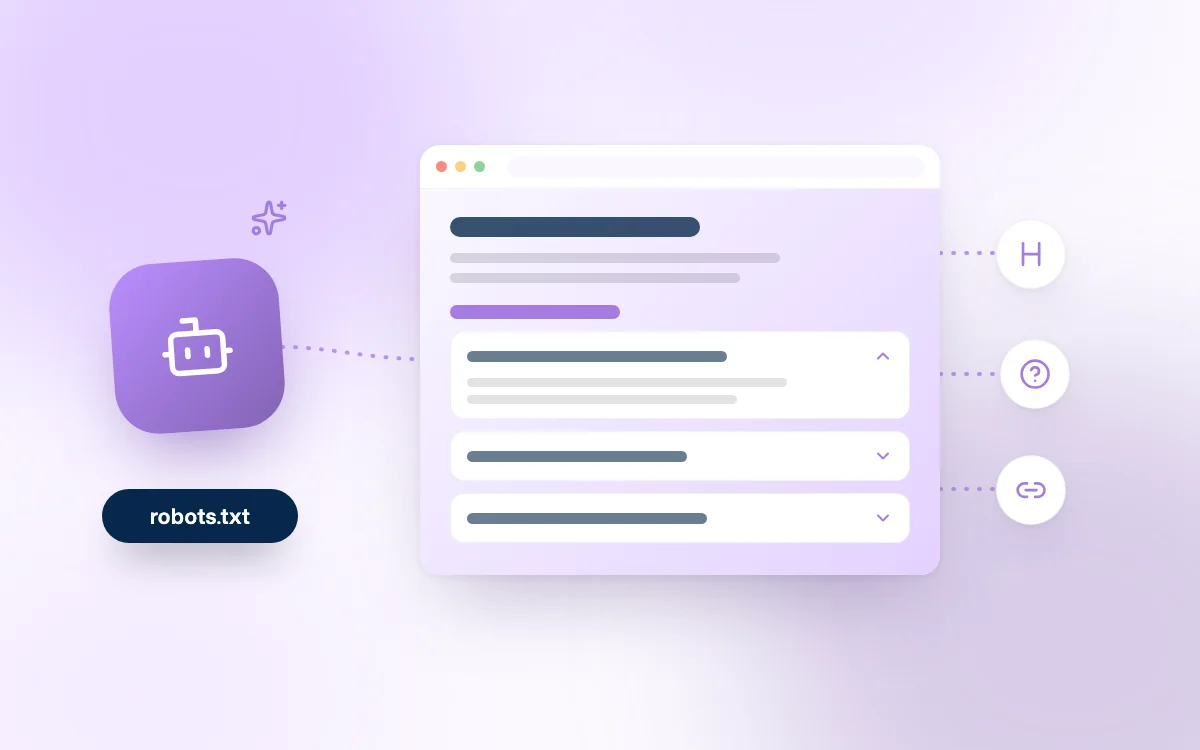
This is a small text file at the root of your site (accessible at your-site.com/robots.txt) that gives instructions to robots.
Make sure there is no line saying Disallow: / for agents such as GPTBot (OpenAI) or PerplexityBot. If you use WordPress, plugins like Yoast SEO let you change this in a few clicks.
The first sentences of each paragraph are crucial. Give the most important information first, then expand on it.
AI agents often extract fragments. If your answer is hidden at the end of a 10-line paragraph, it may well be ignored. Be direct, factual and precise from the very start of your sections.
Robots navigate from link to link. If an important page is not linked from anywhere else on your site, it has little chance of being discovered by the AI.
Create natural bridges between your blog posts and your service pages. This helps the AI understand the overall context of your expertise.
Why can't ChatGPT read my site when Google can?
Google has immense computing resources to simulate a human browser and run every script. Generative AI robots are optimized for speed and pure text extraction; they give up faster when faced with technical obstacles such as pop-ups or complex code.
Should I remove my cookie banner?
No, it is mandatory under the GDPR. However, you must make sure it does not prevent robots from accessing the text content of the page. Use SEO diagnostic tools to check what a robot "sees" when it lands on your homepage.
Does adding an FAQ really help you get cited by Perplexity?
Absolutely. AI search engines favor content that directly answers search intent. A well-structured FAQ acts as a direct connector between the user's question and your expertise.
How can I tell if my site is being read properly by an AI?
The simplest test is to paste your page's URL into ChatGPT or Perplexity and ask it: "Can you summarize the 3 key points of this page?". If it replies that it cannot access it, or if it makes up content (hallucination), your site has technical barriers.
Digital invisibility to AI is not inevitable. By simplifying access to your content and structuring your information logically, you prepare your site for the new era of search.
At Fragments Studio, we see that the companies making this effort toward clarity today are the ones that will dominate visibility tomorrow. It is not about pleasing a machine, but about making your expertise as accessible as possible, whatever tool your future clients use.
Your website is your first salesperson: make sure it is understood by every search engine, human and artificial alike.
Follow Fragments Studio on Google
Add us to your preferred sources and our articles get surfaced first in Top Stories, AI Overviews and AI Mode.
 Tech · 6 min
Metabase for SMBs: centralize your data, build dashboards and track your KPIs in real time. A comparison with Power BI and Looker, and the tool's limits.
 Tech · 6 min
Using Cursor as a team in 2026: how to set up .cursorrules, share context, keep your code secure and compare Cursor with Claude Code and Copilot.
 Tech · 7 min
Scalable software architecture for SaaS in 2026: modular monolith or microservices, horizontal scaling, caching, message queues and the mistakes to avoid.
Fragments Studio handles everything: from strategy to production.
Discuss my project