Metabase: a data dashboard to run your business in 2026
Metabase for SMBs: centralize your data, build dashboards and track your KPIs in real time. A comparison with Power BI and Looker, and the tool's limits.
 Tech · 6 min
The era of traditional SEO is giving way to GEO (Generative Engine Optimization). In 2026, the priority is no longer just to be indexed by Google, but to be fully understood and cited by AI agents such as ChatGPT, Claude and Perplexity. Here is how to technically structure your site to become a reference source for language models.
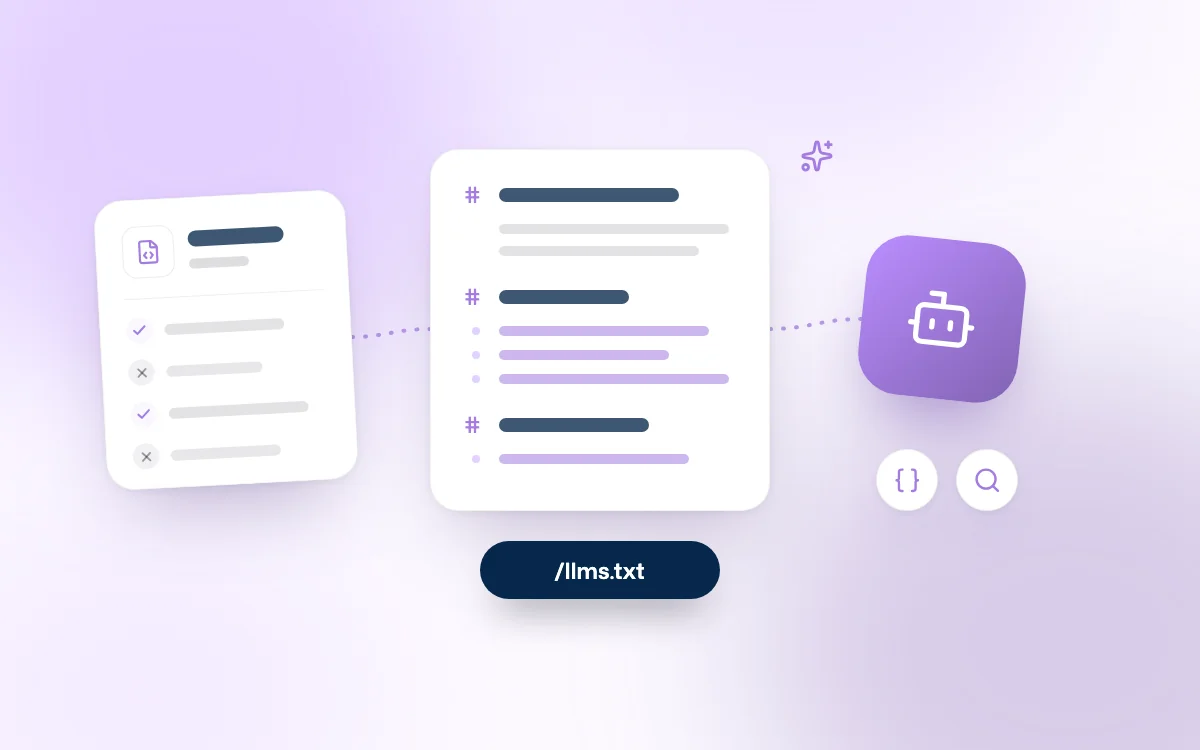
llms.txt is a text file in Markdown format, placed at the root of your server (e.g. https://your-site.com/llms.txt), specifically designed to provide a concise, structured version of your information to Large Language Models (LLMs).
Unlike classic HTML, often cluttered with tracking scripts, advertising modals or complex DOM structures, llms.txt offers AI bots a "fast lane". It lets them extract the very essence of your content without needlessly consuming context tokens.
The implementation must follow a simple Markdown structure to ensure maximum compatibility:
# Fragments Studio
> Web and product development agency specializing in AI and custom software.

## Technical Documentation
- [Web Services](https://www.fragments-studio.com/expertises/agence-application-web-saas): High-performance application development.
- [AI Expertise](https://www.fragments-studio.com/expertises/agence-integration-ia): Integration of generative models and agents.

## Reference Articles
- [GEO Guide 2026](https://www.fragments-studio.com/blog/post/geo-generative-engine-optimization-seo-2026): How to optimize for AI engines.
At Fragments Studio, we see that sites with a clean llms.txt file experience a significant increase in the relevance of their citations in Perplexity and SearchGPT.
In 2026, the robots.txt file is no longer used only to prevent private pages from being indexed. It is used to arbitrate between "being cited" and "being used for training". For a CTO or a marketer, the question is no longer whether to block everything, but how to filter User-agents intelligently.
Here are the main agents you need to manage today:
To maximize your visibility while protecting your sensitive data, we recommend a granular configuration:
User-agent: GPTBot
Allow: /blog/
Allow: /documentation/
Disallow: /admin/

User-agent: PerplexityBot
Allow: /

User-agent: ClaudeBot
Allow: /public-data/
Disallow: /internal-case-studies/
Strategic note: Fully blocking GPTBot will prevent ChatGPT from citing your link in its answers. If your goal is to acquire traffic through AI, leave open access to your high-value content.
Structured data (JSON-LD) consists of code snippets that translate your site's text content into entities machines can understand. For an AI, reading a paragraph is an exercise in probability; reading a JSON object is a certainty.
Using the Schema.org vocabulary is the most powerful lever for GEO. According to recent studies published in late 2025, pages using complete schemas are 33.9% more likely to be extracted for Google's AI Overviews.
Organization: Define your brand, your social networks and your services.Product: For SaaS and e-commerce, include prices, reviews and availability.TechArticle: For your technical guides, specify the level of expertise and the prerequisites.FAQPage: Crucial for AIs to extract Question/Answer blocks directly.{
"@context": "https://schema.org",
"@type": "Service",
"name": "Custom Web Development",
"provider": {
"@type": "Organization",
"name": "Fragments Studio"
},
"description": "Building scalable web applications optimized for the challenges of 2026.",
"areaServed": "France"
}
To successfully make your site "AI-Ready", you need to stack these three layers:
This three-part approach ensures that your content will not only be read, but favored when LLMs generate answers, because it reduces their computational effort.
Does the llms.txt file replace sitemap.xml?
No. The sitemap.xml lists all your URLs for traditional search engines. llms.txt is a strategic selection of content in Markdown format to help AIs quickly understand the essentials of your site.
Is allowing GPTBot dangerous for my intellectual property?
It depends on your business model. If your value lies in the exclusivity of your data, block it. If your value lies in your visibility and authority, allow it so you appear among the sources cited by ChatGPT.
Where should I place my llms.txt file?
It must be placed at the root of your main domain, for example https://your-domain.com/llms.txt. That is where AI agents will look for it by default.
How can I check whether my structured data is valid for AI?
Use Google's Rich Results Test tool or the Schema.org validator. An error in your JSON-LD can make your page unreadable for an autonomous agent.
Optimizing your technical architecture for AI is not just a trend, it is a matter of digital survival. By implementing an llms.txt file, refining your robots.txt and systematizing structured data, you turn your website from a simple brochure into a structured knowledge base ready to feed your customers' intelligent assistants.
Do you want to make your platform or your SaaS fully compatible with next-generation AI agents?
Follow Fragments Studio on Google
Add us to your preferred sources and our articles get surfaced first in Top Stories, AI Overviews and AI Mode.
 Tech · 6 min
Metabase for SMBs: centralize your data, build dashboards and track your KPIs in real time. A comparison with Power BI and Looker, and the tool's limits.
 Tech · 6 min
Using Cursor as a team in 2026: how to set up .cursorrules, share context, keep your code secure and compare Cursor with Claude Code and Copilot.
 Tech · 7 min
Scalable software architecture for SaaS in 2026: modular monolith or microservices, horizontal scaling, caching, message queues and the mistakes to avoid.
Fragments Studio handles everything: from strategy to production.
Discuss my project