Web accessibility: RGAA and EAA compliance in 2026
The European Accessibility Act has been in force since 2025. Learn how to make your website RGAA and WCAG compliant to avoid penalties in 2026.
 Design · 7 min
Since its launch in late 2025, Figma Weave has radically transformed the way product teams design and iterate. By merging generative AI with the power of collaborative design, this tool does more than automate tasks: it redefines the synergy between Product Managers, Product Owners and Designers.
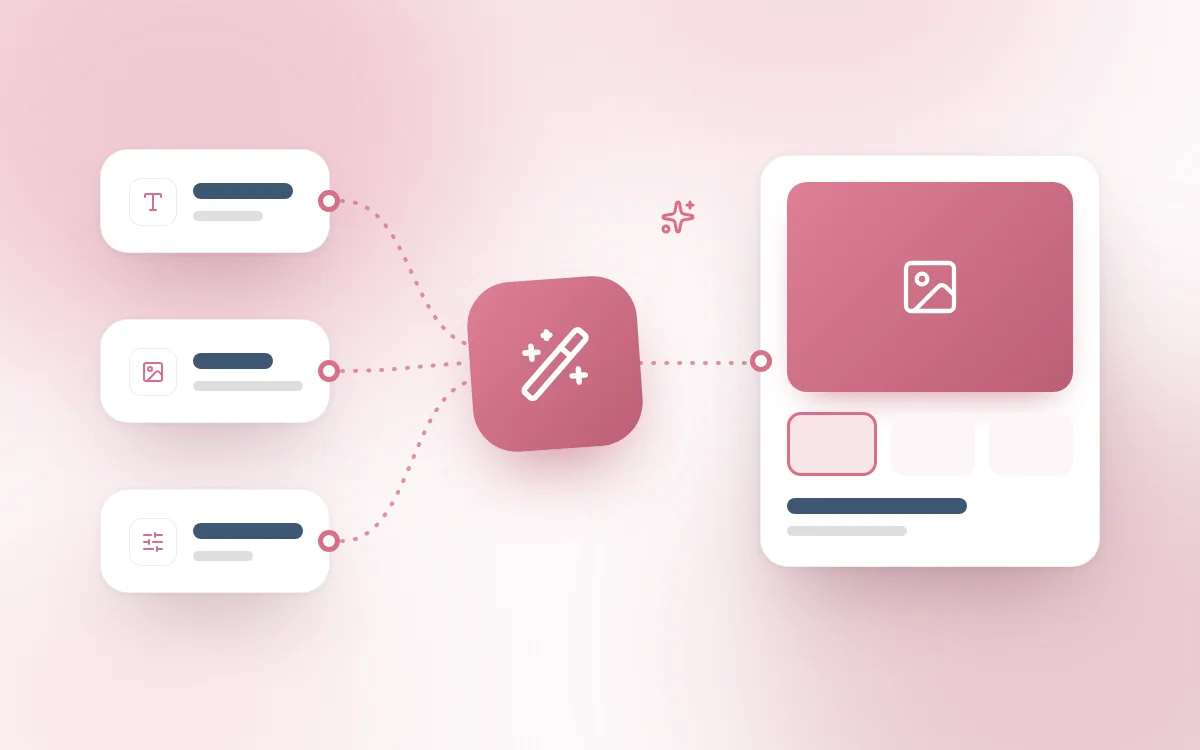
Figma Weave is an AI-assisted multimedia creation platform, integrated into the Figma ecosystem, that uses a node-based system to generate and edit complex images, videos and animations.
Unlike classic AI tools that rely on a single text prompt, Weave lets you structure visual workflows in which each node represents an instruction, an AI model (such as Flux or Sora) or a professional editing tool.
In 2026, Figma Weave has become the essential technical bridge for teams that want to go from idea to high-fidelity prototype without the usual friction. According to early feedback from enterprise use, Weave enables a 50% reduction in the production time of visual assets for complex interfaces.
For the Fragments Studio teams, this tool marks the end of the static design era. It makes it possible to manipulate dynamic content (video, motion, 3D) with the same agility as a simple rectangle on a canvas.
For the Designer, Figma Weave does not replace creativity; it augments it. The major impact lies in the ability to explore variants at industrial speed while keeping granular control over the result.
One of the main shortcomings of generative AI in 2024 was its lack of reproducibility. With Figma Weave's node-based system, a designer can "weave" precise rules:
The Design System now gains a generative dimension. Instead of manually creating 50 icons or 20 promotional banners for an e-commerce site, the designer configures a Weave workflow.
An internal study at Figma shows that designers using Weave spend 70% less time on pure production tasks, allowing them to focus on the overall UX and product strategy.
The role of the Product Manager (PM) and the Product Owner (PO) has often been limited by the technical barrier of visual creation. Figma Weave brings down that barrier by enabling fast iteration from the scoping phase onward.
Figma Weave allows POs and PMs to turn abstract concepts into tangible prototypes without waiting for a full design cycle.
During a discovery sprint, a PM can use Figma Weave to generate realistic assets and animated user journeys. This makes it possible to test user appetite with a level of fidelity that would previously have required weeks of work.
At Fragments Studio, we see that projects using Weave from the product scoping phase see their specification validation rate increase by 30%.
Figma Weave makes it possible to embed videos and micro-animations directly into specification documents. Rather than painstakingly describing a complex transition in a Jira ticket, the PO can generate a visual example in a few clicks through a Weave workflow preconfigured by the design team.
Figma Weave's real tour de force in 2026 is its ability to unify the language between the different stakeholders.
| Feature | Designer benefit | PM / PO benefit | Developer benefit |
|---|---|---|---|
| Node-based Workflows | Total creative control | Understanding of the logic | Reusable business logic |
| Multimodal Generation | High-quality assets | Shorter time-to-market | Fewer manual asset requests |
| Canvas Integration | Unified workflow | Better project visibility | Clear visual documentation |
By connecting AI generation tools directly to the collaborative canvas, Figma Weave reduces what we call "communication debt". Everyone sees the same thing, at the same time, with the same level of detail.
This transparency is crucial to the success of the custom tools we develop.
What is Figma Weave's node-based system?
It is a visual interface where the user connects blocks (nodes) to create a workflow. Each block performs an action: generating an image, applying a filter, animating an object or combining two sources. This allows far more precise control than a simple text prompt.
Does Figma Weave replace tools like Adobe Firefly or Runway?
Rather than replacing them, Figma Weave aims to centralize them. In 2026, many plugins make it possible to use Firefly or Runway models directly inside Weave's node-based interface, while staying within Figma's collaborative environment.
Do you need technical skills to use Figma Weave?
For basic functions (simple generation), no particular skills are required. However, to create complex, automated workflows, an understanding of node-based logic is necessary. It is a skill that is increasingly valued among Product Designers.
How much does Figma Weave cost in 2026?
Figma Weave is generally included in the Enterprise and Organization plans, with a credit system for AI generation (Compute Credits). For smaller teams, a freemium version lets you test the basic features before moving to a paid subscription.
The arrival of Figma Weave marks a turning point: we have moved from a drawing tool to a creation system tool. For POs, PMs and Designers, this means less time spent on technical execution and more time devoted to problem solving and user innovation.
In 2026, ignoring Figma Weave means agreeing to work with one hand tied behind your back in a market that demands absolute responsiveness.
Integrating AI into your design and development process is a major opportunity to boost productivity.
Follow Fragments Studio on Google
Add us to your preferred sources and our articles get surfaced first in Top Stories, AI Overviews and AI Mode.
 Design · 6 min
The European Accessibility Act has been in force since 2025. Learn how to make your website RGAA and WCAG compliant to avoid penalties in 2026.
 Design · 7 min
How to build a high-performing design system in 2026 without creating a bloated monster. A complete guide to tokens, Storybook and design governance.
 Design · 6 min
Transparency, error handling, human escalation, the right tone of voice: master the 7 rules for designing successful conversational AI interfaces.
Fragments Studio handles everything: from strategy to production.
Discuss my project