Metabase: a data dashboard to run your business in 2026
Metabase for SMBs: centralize your data, build dashboards and track your KPIs in real time. A comparison with Power BI and Looker, and the tool's limits.
 Tech · 6 min
Scaling a web application is not only about code quality, it is also about how smoothly that code reaches the end user. For an SMB or a scale-up in 2026, adopting a high-performing CI/CD pipeline is no longer a technical luxury: it is the essential engine of software stability and commercial velocity.
CI/CD is a set of practices that automate the development, testing and production release phases of software. It rests on two pillars: continuous integration (CI) and continuous deployment (CD).
Continuous integration means merging code changes into a shared branch several times a day. Each change automatically triggers a test suite to check that the new code does not break what already exists. Continuous deployment, for its part, ensures that every validated version of the code is automatically deployed to an environment (staging or production) without manual intervention.
In 2026, the challenge for an SMB is no longer just to ship, but to ship with confidence. According to the DORA (DevOps Research and Assessment) report, the highest-performing companies, those that use automated pipelines, show a change failure rate below 15% and are able to deploy several times a day. For a small team, that means less 'go-live stress' on Friday evenings and the ability to react instantly to user feedback.
The massive arrival of AI in developers' daily work has changed the equation. Coding assistants, agents and vibe coding make it possible to produce far more lines, faster. The volume of code reaching review and production is growing, while the human time available to read it line by line is not keeping up.
This is precisely where a mature CI/CD pipeline becomes the team's safety net. On every push, it automatically runs the critical guardrails:
The result: even with less human review time, the quality of what ships stays under control. The most effective teams thus speed up their Time to Market (TTM) without sacrificing either code quality or how the application works. AI speeds up production; CI/CD ensures that this acceleration does not turn into technical debt or regressions in production.
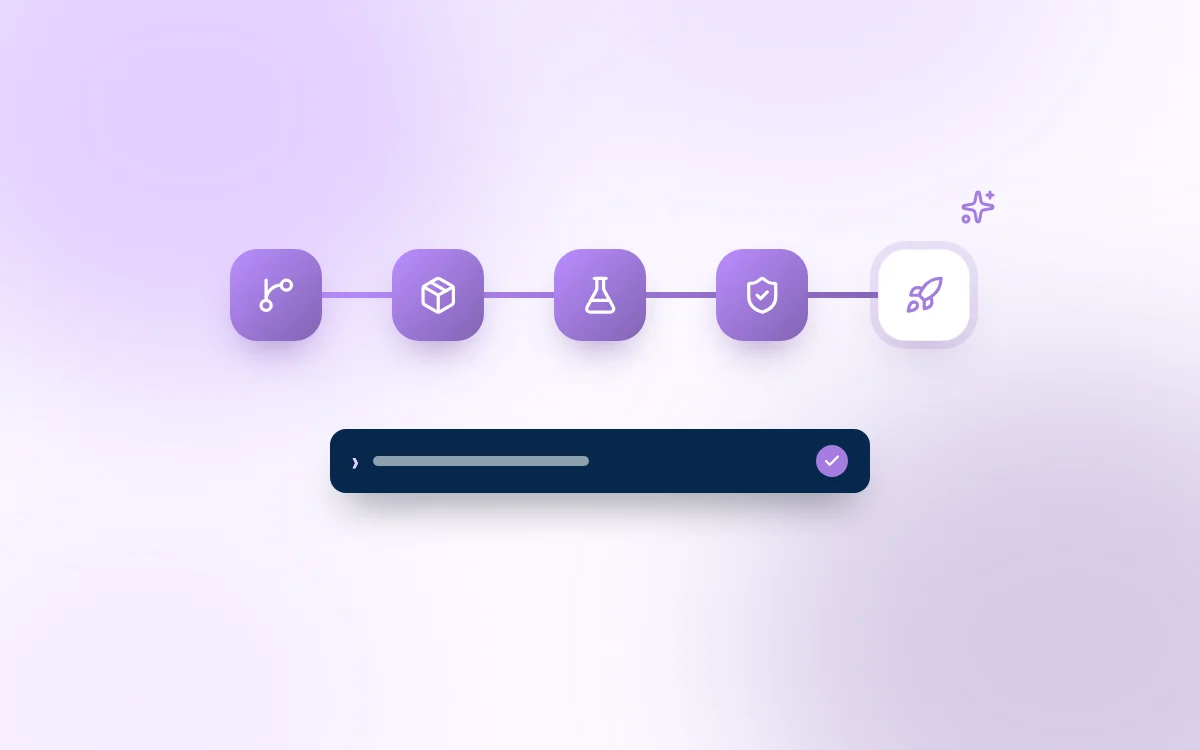
The classic mistake is trying to build an overly complex machine from day one. A CI/CD pipeline must serve the product, not the other way around. Here is the anatomy of a pragmatic and robust deployment chain.
Everything starts with the trigger: a developer pushes code to GitHub or GitLab. The pipeline compiles the project and runs the unit tests. This step must be fast (under 5 minutes). If a test fails, the process stops immediately, preventing faulty code from polluting the shared codebase.
Once the build is validated, we move on to integration tests. In 2026, we systematically include automated vulnerability scans. The goal is to detect outdated dependencies or security flaws before the code even leaves the development environment. This is what is called Shift Left Security.
Validated code is sent to staging for a final validation (QA). If everything is green, it goes to production. But industrialization does not stop there: a mature pipeline must include an automatic rollback strategy. If the application's health metrics drop after a deployment, the system must be able to revert instantly to the previous version without human intervention.
The DevOps tooling market has stabilized, and two players dominate for SMBs and scale-ups. The choice depends mainly on your current infrastructure.
| Criterion | GitHub Actions | GitLab CI |
|---|---|---|
| Integration | Native and seamless if your code is already on GitHub. | Built into an all-in-one platform. |
| Ecosystem | Huge library of community-built, preconfigured actions. | Very powerful for self-hosting and governance needs. |
| Ease of use | Very accessible for getting started quickly without complex configuration. | Slightly steeper learning curve but more flexibility. |
| Pricing | Based on build minutes (often generous for SMBs). | Per-user model with minute limits. |
At Fragments Studio, we often favor GitHub Actions for its simplicity and its ability to interface with modern architectures. For complex projects that require full control over runners, GitLab CI remains a strong alternative. What matters is choosing the tool that requires the least maintenance from your teams.
Automating for the sake of automating is a trap. We regularly see three mistakes that turn a growth lever into a bottleneck:
In our projects, we treat infrastructure as code (Infrastructure as Code). This lets us guarantee that the test environment is an exact clone of production. Our approach rests on three key principles:
The ROI of such an approach is immediate: a drastic reduction in Lead Time for Changes (the time between writing a line of code and putting it live) and a better quality of life for developers, who can focus on creating value rather than handling deployment bugs.
What is the difference between Continuous Delivery and Continuous Deployment? Continuous Delivery automatically prepares the code for production, but requires manual approval for the final click. Continuous Deployment automates the entire process all the way to actual release to users, without human intervention.
Is CI/CD too expensive for a small SMB? Not at all. Most tools such as GitHub Actions offer generous free tiers. The real cost is the human time lost fixing manual errors and handling stressful deployments.
How long does it take to set up a CI/CD pipeline? For a standard web application, a first working version (Build + Unit tests + Automatic deployment) can be set up in 2 to 3 days. Refinement then happens gradually as the product's needs evolve.
Do you need to test 100% of the code before deploying? No, aiming for 100% coverage is often counterproductive. It is better to focus on your business's critical flows (shopping cart, sign-up, payment) to ensure the essentials work perfectly with every release.
Industrializing your deployments through CI/CD is not just a technical transformation, it is a cultural shift. In 2026, a company's ability to iterate quickly on its product is its main competitive advantage. A well-oiled pipeline reduces risk, improves the Developer Experience and delivers measurable ROI through the stability of your services.
Industrializing your deployments is the key to unlocking your technical teams' potential.
Follow Fragments Studio on Google
Add us to your preferred sources and our articles get surfaced first in Top Stories, AI Overviews and AI Mode.
 Tech · 6 min
Metabase for SMBs: centralize your data, build dashboards and track your KPIs in real time. A comparison with Power BI and Looker, and the tool's limits.
 Tech · 6 min
Using Cursor as a team in 2026: how to set up .cursorrules, share context, keep your code secure and compare Cursor with Claude Code and Copilot.
 Tech · 7 min
Scalable software architecture for SaaS in 2026: modular monolith or microservices, horizontal scaling, caching, message queues and the mistakes to avoid.
Fragments Studio handles everything: from strategy to production.
Discuss my project